

 AHFE Open Access
Human Factors in Sports, Preventive Medicine and Innovative Agonology
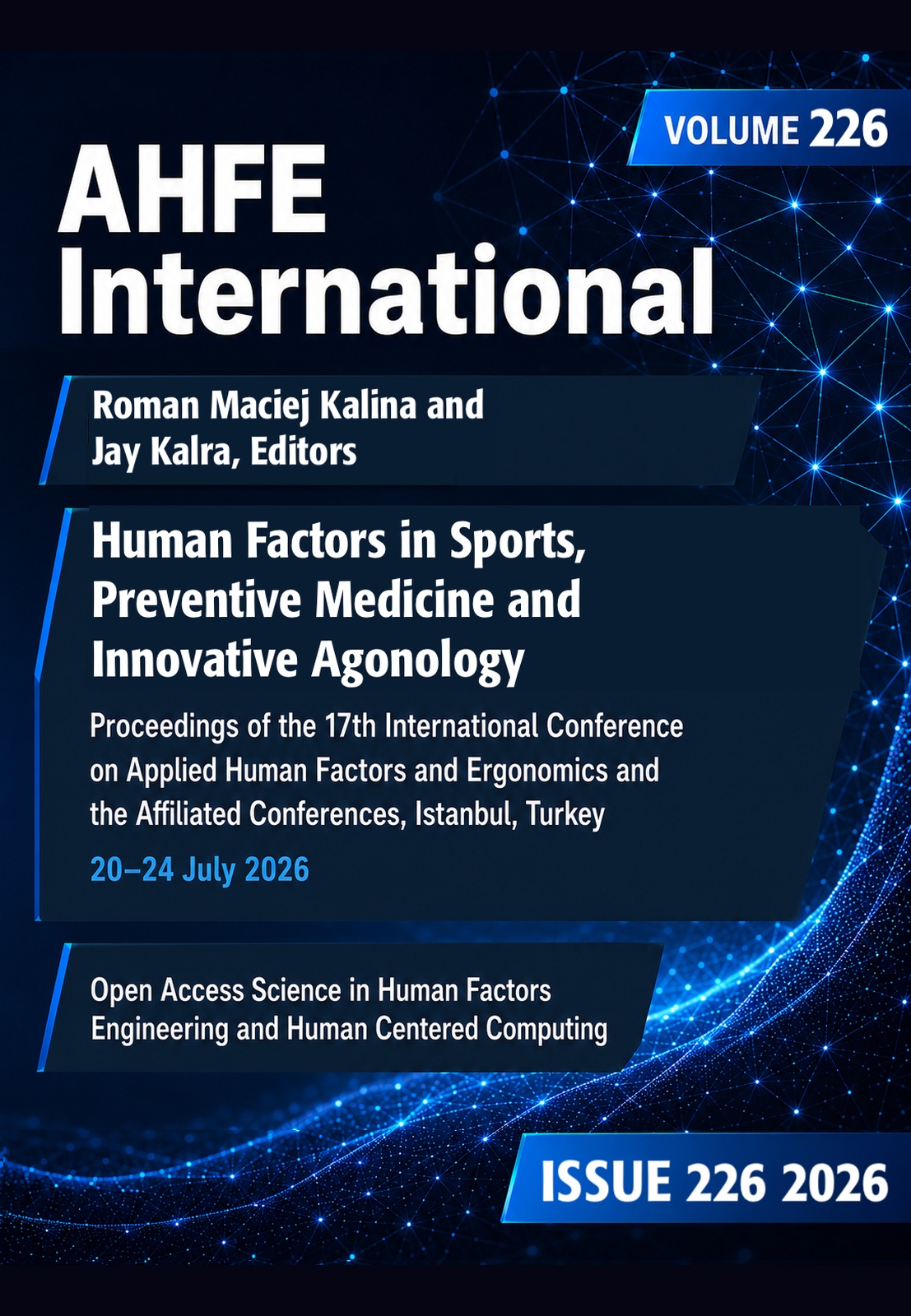
Editors: Roman Maciej Kalina, Jay Kalra
Topics: Healthcare and Medical Devices
ISBN: 979-8-950676-02-4
DOI: 10.54941/ahfe1007245
Table of Contents
Physical activity of older people based on exercises in various forms of combat sports as a prevention of unintentional falls
Falls are one of the most serious health risks in the elderly population and are a significant public health problem. One of the best-documented strategies for preventing falls is regular physical activity in the form of planned and structured exercise. Exercise programmes have a beneficial effect on key risk factors for falls, such as muscle strength, balance control and gait quality.A characteristic feature of many forms of hand-to-hand combat is the integration of motor and cognitive components, which makes them particularly valuable in preventing falls, which often occur in situations requiring simultaneous information processing, posture control and motor adaptation to changing environmental conditions.Mastering the appropriate motor techniques, including elements of safe falling, enables a more conscious response even in conditions of sudden loss of balance.The aim of this publication is to present the importance of introducing physical activity through martial arts as a multidimensional strategy for preventing falls in older people.Appropriately modified elements of combat sports and hand-to-hand combat systems – without competition and injury – are a tool that supports primary and secondary fall prevention. However, the effectiveness of such programmes depends on their competent implementation and individual adaptation to the participants' abilities.
Artur Kruszewski, MICHAL KRUSZEWSKI, Michal STANISZEWSKI
Open Access
Article
Conference Proceedings
The ability to act precisely before and after warming up educational sessions with adolescent violinists – pilot profiles
Although the ability to perform precise actions determines the effectiveness of many human activities, it is not sufficiently emphasized in motor skills research. In the case of musicians, the degree of this motor skills should be correlated with the artistic effects of musical art. However, basic knowledge regarding whether this hypothesis has been sufficiently empirically verified is lacking. The fundamental dilemma concerns the tools that can be used to relatively universally measure the ability to perform precise actions under various circumstances, including those involving physical exertion, often combined with mental stress. The aim of this pilot study is the profiles of four young violinists (11-12 years old), who differ in years of practice and achievements in national and international competitions for beginner violinists. During four months of observation of standard violin lessons at a state primary music school in Poland, one session each month was arranged, preceded by a very simple yet emotionally attractive warm-up. However, before and after a five-minute, quite intense warm-up, the students attempted to throw five rehabilitation bags into a container within 10 seconds, initially from a distance of 2 meters (during the first two sessions) and from a distance of 1.5 meters during the remaining sessions. Effectiveness is measured by the proportion of successful throws, separately with the right and left hands. The analytical calculations also included the overall effectiveness (%) of 80 throws performed by the individual, the time taken for each series of throws (accurate to one hundredth of a second), and the correlations between these indicators for each student separately. Ann, an 11-year-old second-year music student, leads in overall throw effectiveness (47.25%), while Gabi (a 12-year-old sixth-grade student, i.e., with the longest experience and no significant artistic achievements) has 41.25%. Winners of numerous violin competitions: Eve 47.5%, Lucy 46.25%, respectively. Differentiating the calculated indicators when all students are taught by the same expert excludes the influence of the quality of teaching on the results of artistic achievements and innovative use of motor tasks in seemingly disparate physical activities. Therefore, this direction of complementary research seems to be an appropriate recommendation for the search for universal indicators for measuring the ability to act precisely in various states of arousal due to physical exertion combined with the influence of mental stress factors.
Elizabeth Waszkiewicz
Open Access
Article
Conference Proceedings
MMAWW ̶ an abbreviation of ‘martial arts without weapons’ as an attractive incentive to intensify the promotion of neogladiatorism
Simply prefixing this name with the word ‘mixed’ (abbreviation: MMAWW) gives promoters of bloody hand-to-hand combat spectacles a new opportunity to dominate the social space with the message that the centuries-old tradition of martial arts in numerous cultures is nothing more than an attractive spectacle. The aim of this work is to present arguments supporting this pessimistic outlook versus the optimistic alternative. Already today, the dominance of such a message in a sense exposes scholars and educators who provide evidence of the multidimensional health and utilitarian benefits of a significant part of the movement forms of almost every more or less coherent hand-to-hand combat system to ridicule. Therefore, the position of the editorial board of the journal ‘Archives of Budo: Journal of Innovative Agonology’, as well as the Scientific Advisory Board AHFE of the Conference Track ‘Preventive Medicine and Innovative Agonology’, sounds alarmist: with the current low public awareness of the health and humanistic potential of prudent hand-to-hand combat practice, science may lose its real influence in compensating for the pathology of neogladiatorialism. The optimistic aspect is linked to the need for interdisciplinary research teams to address this issue in cooperation with prestigious entities and institutions with the greatest social influence. A key competence is proficiency in the use of complementary research methodology as the number of indexed publications whose authors raise issues of hand-to-hand combat in terms of health and survival is significantly lower than the number of works dedicated to medicine, the latest technologies and other fashionable areas of exploration. Two innovative reviews of scientific publications – review of residuals and omitted implications – deserve even more attention.
Michal Kruszewski
Open Access
Article
Conference Proceedings
In the Age of Artificial Intelligence (AI): Worldview, Political Preferences, and Sexual Orientation – Utopia or Realistic Prevention
Since the days of relatively established social structures, at least one of three phenomena has been the cause of conflicts with oneself or with those in one's immediate and wider environment: worldview, political preferences, and sexual orientation. The cognitive goal of this essay is to present the author's view on three phenomena of key importance for reducing conflicts with oneself and in interpersonal relationships. Hope lies in leaders with a distinct creative power syndrome, for whom classifying people according to such criteria is counterproductive in many ways in the long run. Unfortunately, it would be utopian to claim that artificial intelligence will be able to cyclically select candidates for the highest offices in states and representatives of international bodies in the future, so such a prospect cannot be an indicator of mental and social health. However, this conclusion does not disqualify AI as a tool to support effective prevention in both dimensions of health.
Roman Maciej Kalina
Open Access
Article
Conference Proceedings
Financing the removal of the effects of natural disasters in physical culture facilities by local government units in Poland
Natural disasters increasingly challenge the stability of social infrastructure, with physical culture facilities intended for sports, physical education, tourism, recreation, and physical rehabilitation being particularly vulnerable to climate-related shocks. The objective of this research is the knowledge about the spatial and temporal dynamics of expenditures incurred by Polish local governments for restoring physical culture facilities affected by natural disasters. The study evaluates the fiscal response of Polish Local Government Units (LGUs) to the damage caused by natural disasters between 2008 and 2024. By integrating data from the EM-DAT international disaster database and the Polish Local Data Bank (BDL), this research identifies critical spatial and temporal patterns in recovery spending. The analysis reveals a significant geographical disparity: while disaster-related expenditures at the provincial level were concentrated almost exclusively in the Dolnośląskie and Podkarpackie provinces, municipalities and cities with county rights across most of Poland – with the exception of the Podlaskie and Zachodniopomorskie provinces – faced recurring financial burdens. Notably, the data highlights 2010, 2011 and 2024 as pivotal years for disaster relief funding, particularly in Dolnośląskie province. In the case of the budgets of municipalities and cities with county rights, the highest expenditures for disaster relief were recorded in 2011. The findings suggest that current financing models remain largely reactive. The paper argues for a strategic shift toward proactive fiscal resilience to ensure the long-term sustainability of physical culture infrastructure in disaster-prone regions.
Zbigniew Norbert Piepiora, Justyna Bagińska, Paweł Adam Piepiora
Open Access
Article
Conference Proceedings
Reducing the risk of falling and teaching safe falling as a basic element supporting health resort treatment
The problem of falls and their consequences in people of all ages is widely recognized. Numerous programs have been developed to reduce the risk of falls. The authors of the Polish Falling Safety School focused on reducing the effects of falls, i.e., injuries caused by loss of balance and impact with the ground. Combining programs aimed at reducing falls and their consequences contributes to a reduction in the number of falls, and therefore in unintentional deaths, injured body parts, years lived with disability, and the enormous costs incurred due to these events and their subsequent consequences. Implementing such programs will significantly improve personal safety and quality of life.The aim of this study is to recommend programs that reduce the effects of falls and teach safe falling techniques as a fundamental element of supportive spa treatment.A review of selected literature provides evidence of the effectiveness of methods for reducing the effects of falls in people of various ages and abilities. Italians and Spanish schools have introduced a program called "Safe Falls Safe School," which aims to teach schoolchildren appropriate behavior during falls and thereby mitigate their effects. In Poland, courses on the "theory and methodology of safe falling" have been offered for many years to physiotherapy students. In 2024, a program for seniors living in nursing homes was also launched in Poland. Despite research findings, reducing the risk and effects of falls and teaching safe falling are not widely implemented in Poland. In the context of spa treatment, which aims to improve the patient's functional capacity and overall well-being, reducing the risk of falls and teaching safe falling should be an integral element of prevention and therapy. A comprehensive approach, encompassing diagnostics, functional training, education, and psychological support, significantly improves patients' quality of life and reduces anxiety. Incorporating these activities into daily spa practice will significantly increase the effectiveness of therapy and reduce the risk of post-traumatic complications.
Patryk Wicher, Anna Wicher, Michał Mółka, Bartłomiej Gąsienica Walczak
Open Access
Article
Conference Proceedings
The ability to act precisely during various states of body arousal – alternative profiles of the students
Assessing the ability to perform precise tasks under conditions of fluctuating physiological arousal is currently one of the most pressing research topics, as it is a key component of many sports and occupational activities. The aim of this study is to propose profiles of precision abilities under conditions of increasing physical exertion based on a simple laboratory protocol. The accuracy of five basketball shots taken from a distance of 2 meters within 10 seconds was assessed. Measurements were conducted under five different conditions: before warm-up, after warm-up, and three times after 60 seconds of intense physical exertion, with three-minute periods of active rest. The analysis included two groups of students: those who were regularly physically active (A) and those who were inactive (P). Task performance accuracy and stability were assessed as indicators of precise movement during increasing physical exertion. In group “A,” the two most effective students (each with 92% throwing accuracy) differed in terms of the stability of their extreme scores. Leader’s score profile (%) from task 1 to task 5: 100/100/100/80/80. Performance profile of the inconsistent student: 100/80/100/80/100. Among the leaders of Group “A,” higher minimum performance stability was observed at the 80% (n = 3) and 60% (n = 2) levels. Regular physical activity helps maintain high performance and stability of motor skills during situations of increased exertion. The assessment protocol used can serve as a simple diagnostic tool, useful both in sports and in areas of activity related to safety and health education.
Robert Bąk
Open Access
Article
Conference Proceedings
Physical Activity and Selected Health Behaviors of Tourism and Recreation Students
Physical activity is crucial for the health and harmonious psychophysical development of students, in terms of their healthy habits and attitudes later in life. During this period, it also serves as a natural continuation of physical education classes undertaken at lower levels of education. Students, as the future intelligentsia group, should serve as role models for other social groups. The aim was to develop knowledge about physical activity and other health behaviors among university students. The study included a group of 32 students of Tourism and Recreation. The participants were aged 22-24. The International Physical Activity Questionnaire (IPAQ), accepted in 12 countries (Sjöstrom et al. 2000), considered the world's most advanced questionnaire assessing the level of physical activity among the population in various countries, taking into account different social groups, was used as the methodology. The International Physical Activity Questionnaire (HBUSQ) was used (Litwiniuk, Grants 2010). It was found that half of the surveyed students had a low level of physical activity in their free time, spending it passively in front of a computer. 30% declared an average level of physical activity, while only 20% reported a high level. It was observed that the lifestyle of the surveyed students, for a significant proportion of respondents, was more health-promoting than unhealthy. Although TiR students are physically active and adhere to healthy lifestyle principles, they also engage in health-risk behaviors, not least those involving irregular meal times. During studies, both practical and theoretical classes should pay more attention to the future consequences of unhealthy behaviors.
Artur Litwiniuk, Behnam Boobani, Juris Grants, Jan Supinski
Open Access
Article
Conference Proceedings
Rider Safety in Outdoor Equestrian Activities: Behavioral and Environmental Approaches
Equestrian sports have significant physical, emotional, and therapeutic advantages but are also associated with high risks, especially in open environments where visibility and communication are restricted. Past studies have emphasized injuries and safety gear while neglecting the complex relationship between environmental conditions, equine behavior, and system coordination in non-elite sports. This research undertakes a qualitative approach by conducting field studies in a rural center in France and using semi-structured interviews with participants from different backgrounds. The research findings reveal three main problems in the current system: the delay in detecting and localizing incidents, fragmented coordination among stakeholders, and equine-related accidents due to stress behavior. In response to the identified problems, three strategies have been recommended in the research. These strategies include improving the riders’ visibility, stabilizing and interpreting equine behavior, and improving communication in emergencies. This research has positioned the role of behavioral risk mitigation in designing as a mediator between humans and horses and the environment.
Qiaohan Lu, Zihao Wang
Open Access
Article
Conference Proceedings
Structured Functional Training Enhances Motor Skill Acquisition and Functional Health in Adolescent Athletes: A Randomized Controlled Trial
Adolescence is one of the stages of development where rapid neuromuscular growth and increased neuroplasticity occur. This is a stage at which training organization can play critical roles in the acquisition of motor skills, coordination of movement, and long-term functionality. Although the results of strength-based training programs are frequently reported in training studies on adolescents, there have been less studies that examine the role of integrative training methods on the efficiency of motor learning and functional adaptation specifically. In the present study, the impact of a systematic functional training program on motor skill-related performance and functional health indicators in young volleyball players were examined. It has been a randomized controlled trial involving 52 male adolescent athletes aged 13 + 2 years who were randomly assigned to the functional training group (FTG n = 26) and traditional resistance training group (TRTG n = 26). After the 12 weeks intervention (3 times a week, 20 in each group) 40 subjects were able to complete the protocol. The functional program aimed at multi-jointed and multi-planar exercises that were based on their tasks with dynamic balance and core stability and sport-specific jump coordinate. Measurement tools included: standing reach height, approach reach height, agility (half-meter square test), standing long jump, sprint speed and endurance performance. Both FTG (P = 0.025; d = 0.74) and AP-R (P = 0.034; d = 0.69) increased significantly indicating better vertical coordination and intermuscular synchronism. Agility performance had moderate effect size (d = 0.58) meaning that it did not statistically differ (P = 0.075). The TRTG experienced excellent increase in agility (P = 0.028, d = -0.72) but no change in vertical performance. Comparison of post-intervention measurements across groups demonstrated no significant differences (all P> 0.05). Integrative and task-oriented characteristic of structured functional training, under the concept of motor learning, has the potential to develop sensorimotor integration and coordinated movement pattern formation during adolescence. Improvements in dynamic balance and coordinated force generation can also be seen as an advantage of joint stability and neuromuscular efficiency, which are aspects of functional health and decreasing the risk of injury. These findings suggest that training structure is a key element in predicting the results of motor learning and provide a foundation to consider other time-based training models that aim at optimizing the development of skills and functional capabilities in the youth population.
Yuan Gao, Ziqi Wang, Yong Li, Yueheng Ma
Open Access
Article
Conference Proceedings
AR-AI Integrated System for Enhancing Safety in Rock Climbing: A Research Design
With the continuous increase in the number of participants in extreme sports and the difficulty of the sports, the perception errors of key spatial information such as distance an d fulcrum by the athletes function as the leading cause of injury accidents. This research is predominantly intended to reinforce the spatial perception ability of extreme sports participants in dynamic environments. On this basis, the research has developed a real-time risk intervention system grounded in augmented reality and smart wearable devices. The system uses a mobile phone to conduct real-time environmental simulation. Through AI technology, it performs depth and edge recognition of climbing paths, fulcrum stability, and dynamic obstacles. The interaction layer adopts a simple collaboration approach. In detail, the phone analyzes the environment, and the watch provides intuitive vibration and visual alerts to keep athletes informed without distraction. As demonstrated by the tests on 25 valid samples of rock climbing and parkour, the error rate of movement decreased by 15% and the performance improved by 10% subsequent to the utilization of this distinctive system. The results verified the feasibility of the AR-assisted perception system in extreme scenarios and provided a new design framework for human-machine collaboration in high-risk environments.
Yang Wen, Yimiao Liu, Ying Yang, Xue Chen, Zhang Ya Ting, Yuxuan Lu
Open Access
Article
Conference Proceedings