

 AHFE Open Access
Usability and User Experience
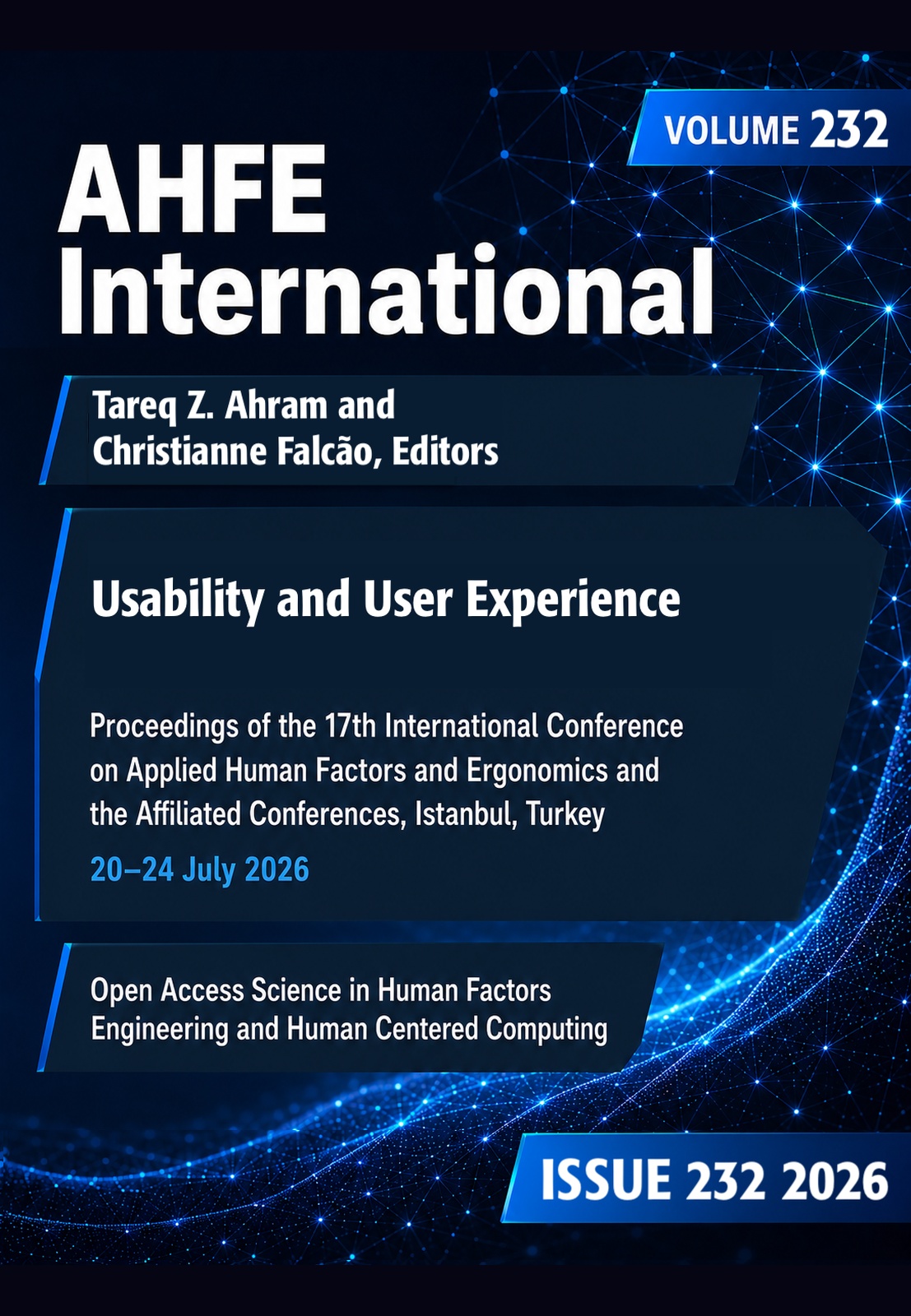
Editors: Tareq Z. Ahram, Christianne Falcão
Topics: Usability & User Experience
ISBN: 979-8-950676-08-6
DOI: 10.54941/ahfe1007251
Table of Contents
Enhancing XR Interface Design through Immersive AR Co-Design and 360-Degree Photospheres
This paper presents a co-design methodology applied to the development of Mixed Reality (MR) interfaces within the Motivate XR project, targeting industrial training and operational support scenarios. The proposed approach emphasizes a user-centered design process, achieved through the continuous involvement of end users alongside developers, with the objective of improving usability while addressing ergonomic and operational constraints. The design process was structured around a systematic, ergonomics-driven methodology, tailored to the specific use cases of multiple industrial pilots. Insights derived from individual case studies were combined to define a design solution adaptable across heterogeneous real-world environments. A series of co-design workshops were coordinated to iteratively present, evaluate, and refine interface concepts based on direct user feedback, ensuring alignment with operational goals. To validate the proposed designs, 360-degree photos and videos of real industrial environments were used to simulate MR interactions within the actual pilot contexts. Interface layouts and visual elements, such as contrast, spatial arrangement, and content readability, were optimized through the creation of MR mockups, supporting both functional effectiveness and perceptual clarity. The methodology placed strong emphasis on real-time user feedback, enabling rapid iteration and continuous refinement of design decisions. The co-design activities were supported by a combination of UX tools and MR technologies, including 2D prototyping platforms and immersive VR environments, facilitating collaborative evaluation and validation. Results demonstrate that co-design represents an effective strategy for the development of scalable, user-centered XR interfaces in industrial contexts, contributing to improved usability and stronger alignment between technical solutions and end-user needs.
Antonio Zingarofalo, Giorgio Giustizieri, Sarah De_Cristofaro, Luca Rizzi
Open Access
Article
Conference Proceedings
Designing with the Senses: Emotional Connections for Sustainable Consumption
The two major obstacles facing contemporary society include unsustainable consumption behaviours and a mismatch between consumer values and their actions relative to environmental concerns. Designers have the potential to bridge this gap using sensory design, with its focus on product sensory characteristics, which influence the decisions consumers make. This research aims to examine how different sensory attributes (such as colour, texture, etc.) can encourage consumers to adopt more sustainable behaviours, and therefore help to address the under-explored role of such attributes in determining consumption patterns. The research outlines three objectives: develop a model integrating sensory design with behavioural insights, evaluate the impact of material attributes on perceptions of environmental value, and study user interactions with sustainable materials. The anticipated outcome is a framework that empowers designers to leverage sensory qualities to enhance the emotional connection to sustainable products, ultimately fostering more sustainable consumption cultures.
Amic G. Ho, P. W. Chau
Open Access
Article
Conference Proceedings
Sustainable AI: Exploring Gains and Losses of AI in Daily Routines
Artificial Intelligence (AI) has become part of many people's daily routines and provides support in various areas of life, making their lives more comfortable and manageable. However, a question at hand is, whether the effects of AI on individuals and society are purely positive, and whether the perceived gains will remain a profit in the long-run. Our research reflects on the impacts of AI from a sustainability perspective, considering the psychological human needs (e.g., competence, autonomy, relatedness) that are fulfilled or violated through AI and how these effects might unfold over time. As an empirical basis, we present findings from 32 individuals' documentations of their AI usage behavior, and perceived gains and losses over a ten-day period. The qualitative data analysis resulted in 19 categories of gains, and 17 categories of losses. Based on this snapshot of AI in daily routines, we discuss the effects of AI in relations to psychological needs fulfilment as well as societal effects. We relate our findings to previous research in HCI and psychological concepts (e.g., overtrust, boost technologies, psychological biases), and sketch next steps of research.
Sarah Diefenbach, Lara Christoforakos, Daniel Ullrich, Marie Veihelmann
Open Access
Article
Conference Proceedings
A Usability Evaluation of the Lusog-Isip Mental Health Mobile Application
Lusog-Isip is the first mental health and self-care mobile application developed specifically for Filipinos in response to the increasing prevalence of depression, substance use disorders, and mood disorders among Filipino individuals aged 18 to 24. From its launch in 2021 until April 2023, the application received average user ratings of 3.3 on Android and 3.6 on iOS, based on a five-point scale. User feedback during this period frequently cited usability concerns; however, no formal usability evaluation had been conducted since the application launch. To address this gap, a usability study was conducted involving 21 participants aged 18 to 24. Data were collected using the Post-Study System Usability Questionnaire (PSSUQ), the After-Scenario Questionnaire (ASQ), and ten open-ended questions. Lusog-Isip earned an overall PSSUQ score of 2.13, better than the 2.82 benchmark, indicating that users are generally satisfied with the app's usability. However, the results of the ASQ revealed that users had a hard time accessing the modules. They were also unsatisfied with the time consumed during signup and in accessing the modules. Further, respondents did not strongly agree that enough support information was provided for accessing and troubleshooting errors in the modules. While the findings indicate that the app’s usability is satisfactory, improvements in navigation and accessibility are still necessary to enhance overall user experience and satisfaction.
Nazka Leosala, Paul Rainer De Villa, Lorelie Grepo, Joshua Phillip Reyes, Kaye Domingo
Open Access
Article
Conference Proceedings
Narrative Design Method Innovation: Exploring Paths to Enhance the Story Connotation and User Experience of Cultural and Creative Products
Cultural and creative products serve as vital vehicles for cultural dissemination, where the articulation of narrative substance and its connection to user experience constitute the core driver of value enhancement. However, contemporary design in this field is hampered by prevalent issues: homogenized narrative formats and insufficient emotional resonance between story and user, which impede effective cultural transmission.Focusing on innovating narrative design methodology, this study aims to enhance the narrative depth and user experience of cultural and creative products. Employing a triangulated framework—encompassing literature review, questionnaire surveys, and case study analysis—we clarify the current applications and dilemmas of narrative design in these products and investigate the intrinsic relationships between narrative elements, design techniques, and user experience.This research delineates innovative pathways in design methodology across three dimensions: narrative structure, emotional expression, and interaction modes. Integrating theories from semiotics and affective design, it explores the linkages between narrative meaning, design approach, and user engagement. By decoding the symbolic significance of cultural elements, the study formulates targeted narrative design strategies for cultural products.Through design practice and validation with representative products, this work provides actionable methodological insights for narrative design in this domain. It seeks to propel the evolution of cultural and creative products from mere "cultural symbol presentation" towards "story-driven emotional communication," thereby paving the way for novel applications of narrative design within visual communication.
Jinghuan Xu, Yulin Zhao
Open Access
Article
Conference Proceedings
Mobile Service Design as Cultural Intermediaries for Halal-Related Services
Human interaction with digital services is shaped by cultural context, shared practices, and social expectations. The concept of cultural affordances highlights how users interpret interface cues through culturally grounded knowledge rather than culturally neutral interface properties. These dynamics become particularly important when users must make decisions under uncertainty. For Muslim users navigating halal-related services in non-Muslim-majority countries, verifying the permissibility of food or services often involves interpreting fragmented information, inconsistent labeling practices, and unfamiliar service ecosystems. Mobile applications designed for halal navigation aim to address these challenges by aggregating information about halal restaurants, prayer spaces, and certification indicators. This study evaluates the usability and user experience of halal navigation platforms, using the Japanese mobile application Halal Navi as a case study. A total of 127 Muslim participants who had lived in or visited Japan participated in a mixed-method evaluation combining a task-based assessment using the User Experience Questionnaire (UEQ) and follow-up semi-structured interviews with six participants. Results indicate an overall positive user experience, with pragmatic qualities rated higher than hedonic qualities. The findings highlight the importance of clear navigation, reliable information presentation, and transparent verification cues in supporting culturally informed decision-making.
Tiana Santoso, Chieh-ju Huang
Open Access
Article
Conference Proceedings
The Silent Language of Priority Seating: Invisible Needs, Attention Barriers, and the Legitimacy Crisis in Public Transit
Priority seating in Taiwan aims to serve “those in actual need” but has increasingly become a site of potential conflict. Despite regulatory changes expanding eligibility, friction remains, indicating that current conflicts stem from deep-seated structural issues regarding interactional visibility and moral judgment. To address this, the present study utilizes a two-phase qualitative approach in the Taipei Metro. Non-participant observation of 26 episodes identified five key themes, including attention barriers and information asymmetry. Subsequently, semi-structured interviews (n = 10) elicited motivations and risk trade-offs overlooked by observation alone. Findings indicate that while visible needs usually prompt seat-yielding in the vast majority of observed cases, invisible needs frequently lead to failure. Notably, nearly all Seekers used passive strategies, and more than two-thirds of Givers exhibited attention barriers due to digital immersion. Furthermore, bystander intervention, while effective in some instances, often escalated moral tension. Consequently, this paper proposes actionable interventions: (1) privacy-preserving nonverbal signaling channels; and (2) de-labeled visual communication. These measures aim to reframe seat-yielding from a specific seat obligation to a collective behavioral norm, thereby mitigating social stigma.
Ji-Xian Ho, Chien-Hsiung Chen
Open Access
Article
Conference Proceedings
An Observation on the Accessibility of a Connecting Ramp between Campus Buildings
This study aims to investigate the challenges of circulation integration and regulatory compliance when retrofitting existing campus buildings with accessible facilities. Focusing on the elevated ramp connecting the fourth floors of Buildings 1 and 4 at Taiwan Tech, this study employs on-site measurement, visual documentation, and non-participatory observation for analysis. The research objectives include: (1) analyzing the spatial configuration and dimensions of the ramp; (2) evaluating the degree of compliance with relevant accessibility design codes; (3) identifying actual usage patterns and exploring the underlying causes of low utilization; and (4) examining the continuity of campus circulation to provide improvement recommendations. The findings indicate that while the ramp was installed to overcome elevation differences, discrepancies remain between its current state and modern regulatory standards regarding landing configurations, clear passage width, handrail design, and perceptual recognition. Furthermore, the ramp fails to interface effectively with primary instructional areas, resulting in "circulation breakpoints." Observational data revealed zero usage by individuals with disabilities during the study period and extremely low general traffic, suggesting that the facility possesses formal functionality but offers limited substantive utility. Additionally, the lack of supporting accessible facilities on the same floor further increases the burden on users. This study concludes that campus planning should shift from localized retrofitting toward systemic integration, optimizing entrance and ramp configurations to establish continuous cross-building pathways, while transitioning design paradigms from “regulatory-oriented” to “user-oriented” to foster an inclusive learning environment.
Zhi-hao Shou, Chien-Hsiung Chen
Open Access
Article
Conference Proceedings
A Behavioral Observation on Spatial Configuration and Circulation Planning of the Food Court Area in a Hypermarket
As retail formats and consumer behavior continue to evolve, contemporary retail environments have become multifunctional spaces that support experiential, social, and operational activities. Large-scale, warehouse-style retail formats intensify spatial complexity, particularly under high-density conditions where users’ spatial perception and movement behavior are heightened. Drawing on servicescape theory, behavioral setting theory, and proxemics, this study develops an analytical framework to examine the relationships among personal space, circulation behavior, and environmental stimuli in a high-footfall retail setting. Empirical observations were conducted in the food court of a hypermarket in the Zhonghe District of New Taipei City, Taiwan. The space is segmented into five functional areas, including ordering counters, queueing areas, seating areas, beverage and condiment stations, and recycling areas. Employing non-participant observation and behavioral mapping, pedestrian flows were documented across weekday and weekend lunch and dinner periods at 15-minute intervals. The results show that weekend crowd density significantly increases spatial congestion, with circulation conflicts concentrated at the queueing zone in front of the ordering counters, beverage and condiment stations, and recycling areas. To maintain interpersonal distance, customers frequently detour or reverse direction, which reduces circulation efficiency. Based on these findings, the study proposes circulation strategies including a zigzag one-way guiding route, centralized placement of recycling areas, and buffer zones at critical intersections. This study demonstrates the interdependence of physical environments, psychological perceptions, and behavioral patterns, providing practical and theoretical guidance for circulation design in high-density commercial environments.
Yishi Tan, Chien-Hsiung Chen
Open Access
Article
Conference Proceedings
The Interplay of Gender and Anthropomorphism in AI Avatar Design: An Empirical Study on User Experience in Financial Contexts
The design of AI virtual assistant (AVA) avatars significantly shapes user perceptions and experience. However, the interplay between avatar gender, anthropomorphism, and contextual task demands remains underexplored, particularly in specific cultural settings. Grounded in the Computers Are Social Actors (CASA) paradigm and Social Role Theory, this study investigates how these two key design attributes influence user experience within the financial service context of Hong Kong. We conducted an exploratory mixed-methods experiment employing a 2 (avatar gender: male vs. female) × 4 (anthropomorphism level: none, low, medium, high) design. Fourteen participants interacted with a series of avatar conditions while completing standardized financial tasks, followed by in-depth semi-structured interviews. Quantitative results, interpreted with caution due to the small sample size, indicated no statistically significant effect of avatar gender on perceived trust, emotional engagement, or anthropomorphism. Qualitative thematic analysis revealed three core insights: (1) a strong context-dependency of user preferences, where professional settings prioritize functionality and moderated anthropomorphism, while entertainment contexts favor expressive and customizable avatars; (2) a complex relationship with anthropomorphism, where moderate levels foster trust and approachability, whereas high realism can induce discomfort or psychological distance; and (3) a prevailing neutral stance toward avatar gender in task-oriented financial interactions, though underlying cultural stereotypes still persist. The study contributes by providing nuanced and context-sensitive evidence that explores the applicability of gender in professional AVA design and clarifies the boundary conditions of anthropomorphism's benefits.
Ziyi Chen, Meichen Liu, Mingyuan Zhang, Stephen Jia Wang
Open Access
Article
Conference Proceedings
Design of an Intelligent Product–Service System for Last-Mile Express Delivery in the Chinese Context
The intelligent development of last-mile delivery holds enormous potential in China’s future market. However, the relationship between service quality and user experience in China’s current last-mile delivery market remains fragile, plagued by sporadic conflicts, highly diverse user demands and other pain points. The delivery process is marked by an imbalance: overall disorder coexists with partial orderliness. To improve user experience and satisfaction with last-mile express delivery, and to achieve the goal of cost reduction and efficiency enhancement, it is imperative to build a more intelligent and user-friendly delivery product service system based on a new operational model. Based on the current status of intelligent delivery in the domestic market, this study develops an user-centric design framework for an integrated product-service-environment delivery product service system from three core dimensions: service orientation, system planning and application development. This framework integrates the key elements of last-mile delivery with public facilities and architectural environments within a unified service ecosystem, and underscores the core thread of integrating delivery products with community development. In doing so, it achieves the research objective of shifting from inefficient manual operations to an efficient internet-enabled management model, and provides theoretical reference for the design of tailored solution systems for last-mile delivery product services that cater to personalized user needs.
Xinchao Peng, Pengfei Zhao
Open Access
Article
Conference Proceedings
Beyond Visuals: Addressing Cognitive Load and Usability Challenges in an Enterprise Mobile Application Design
Enterprise organizations rely on mobile dashboards to support performance monitoring and decision making (Few, 2013). They are expected to provide timely access to critical metrics, enable situational awareness, and support fast-paced decision making across distributed teams. However, as enterprise systems evolve and data volume increases, these dashboards often become difficult to interpret. Although the project was initially framed as a visual update, early research pointed to deeper challenges related to usability, information architecture, data comprehension, and workflow alignment. Through a multi-phase mixed-methods research program with 81 enterprise sales users, the study surfaced recurring workflow misalignments, information architecture barriers, and role-dependent information needs that hindered day-to-day use. This program included interviews, surveys, and iterative usability testing. The findings show how user research reframed the problem space, challenged long-held assumptions, and informed design exploration toward clearer data presentation and more effective decision support. This case study highlights the role of user research in revealing systemic experience issues within complex enterprise mobile applications. It also offers insights for designing data-intensive tools that better support how users actually interpret and act on data in mobile contexts.
Soo Yun Kim, Qiwen Zhao, Iain Lowe, Christi Wilbert
Open Access
Article
Conference Proceedings
Systematic business process optimization based on TRIZ: a novel method supported by a user interface
Existing methods for process redesign widely rely on general heuristics and creativity techniques, which can be time-consuming and yet may miss important aspects. Most methodologies do not provide structured guidance for analyzing and optimizing business processes. A novel method for systematic process optimization based on the Theory of Inventive Problem Solving (TRIZ) is presented in this paper. Originally developed for engineering, the authors have adapted TRIZ to the domain of business process management. This method offers new ways of analyzing and optimizing business processes by providing a systematic approach that can be applied by both experts and novices. Significant elements of the method are the use of a database containing use cases and an ergonomically designed human-machine interface (HMI) that facilitates the use of the method and effective interaction with the database. A first qualitative user-centered evaluation suggests that the developed method and the HMI can effectively support users in process analysis and optimization tasks.
Elena Dalinger, Daniel Feiser, Nina Mundt
Open Access
Article
Conference Proceedings
Beyond Random Sampling: Behavioral Targeting As a Human Factors Methodology For Uncovering Latent Citizen Needs In Government Web Services
Government digital services are built on an implicit promise of universal accessibility, yet the methods most commonly used to evaluate them are structurally incapable of capturing the experiences of those who depend on them most. This paper examines a persistent methodological gap in public sector UX evaluation: the reliance on random sampling, which systematically dilutes the feedback of task-motivated citizens with the opinions of users who have never encountered the service's core failure points. Drawing on a case study of a municipal web portal redesign in Japan, we present a behavioral targeting approach in which a real-time analytics platform identifies purposeful visitors — defined operationally by scroll depth — and delivers satisfaction surveys exclusively to this segment. This method is grounded in the principle of ecological validity: measuring users within the context of genuine task performance rather than through decontextualized recall. The targeted survey revealed an overall Net Promoter Score (NPS) of -52.3, a navigation failure rate of approximately 25%, and three prioritized failure dimensions identified through journey map analysis. A subsequent redesign, anchored in smartphone-first architecture and AI-assisted search functionality, produced measurable improvements validated by post-launch citizen feedback. From these findings, we propose a replicable Behavioral Targeting Evaluation Model (BTEM) for public sector usability assessment. The implications extend well beyond the Japanese context: as local governments worldwide accelerate digital transformation, the ability to isolate and address the right users' failures — rather than averaging across the full population — will determine whether digital public services achieve genuine public value.
So Nishina
Open Access
Article
Conference Proceedings
Beyond Vision: Non-Visual Sensory Channels Assist Blind Passengers in Understanding Driving Environments and Vehicle Behavior
In the context of the development of autonomous driving technology, the intelligent cockpit's ability to process information has gradually increased, becoming an important carrier for obtaining driving information and understanding the traffic environment. Unlike traditional human-computer interaction methods dominated by vision, this study focuses on how to provide blind people with relevant information on vehicle status and environmental changes through sensory channels such as touch and hearing during autonomous driving, in order to support their formation of basic cognition of driving situations. The research aims to explore the role of multimodal interaction methods in enhancing the perception ability and riding safety of blind people. The experiment focuses on constructing typical usage scenarios for 10 common scene elements in autonomous driving, using interactive methods such as tactile gloves and car machine prompts as the main sensory channels for transmitting information. By collecting data on users' situational perception ability, scene judgment accuracy, judgment grasp degree, etc., evaluate users' perception ability under different sensory channels. The results indicate that multimodal information feedback can significantly enhance the perception of blind people during autonomous driving, help them better understand vehicle behavior and driving status, and enhance their predictability of the system operation process, providing a reference design basis for barrier free interaction design for blind people in autonomous driving scenarios.
Zhiyang Li, Danhua Zhao
Open Access
Article
Conference Proceedings
Cross-Modal Evidence on Website Interface-Induced Emotions and Search Efficiency in Time-Limited Ticket Purchase
Limited-time purchase interfaces increasingly embed temporal scarcity cues (e.g., countdown timers), requiring users to search and act under time pressure. Yet most evaluations rely on outcome-level indicators, leaving limited process-level evidence on how interface-induced emotions shape search efficiency. This study investigates how valence and arousal in web interface design affect goal-directed search in a timed ticket-purchase flow, integrating subjective affect mapping with synchronized eye- and mouse-tracking. In Study 1, forty participants rated 18 standardized above-the-fold webpage screenshots using a grid-based Circumplex Model of Affect (CMA), positioning each stimulus in valence–arousal space. K-means clustering (k = 4) identified four quadrant-aligned emotional profiles, from which one representative webpage per quadrant was selected. In Study 2, these four emotional profiles were implemented as isostructural ticketing prototypes that held information architecture and task demands constant while manipulating emotion-related design tokens. Thirty participants completed within-subject timed purchase task while eye movements and mouse behavior were recorded. Across repeated-measures analyses and cross-modal evidence fusion, arousal emerged as the most reliable driver of efficiency: higher-arousal interfaces accelerated progression and strengthened gaze-to-action coupling, yielding faster and more stable interaction rhythms. Valence mainly affected local processing fluency but did not consistently reduce total completion time. These findings provide process-level evidence for emotion-aware, efficiency-oriented design in time-pressured purchase interfaces.
Li Shucheng, Yufeng Yang
Open Access
Article
Conference Proceedings
A Systematic Review of Metadata Quality Assessment for Cultural Heritage Digital Resources
As museums, galleries, libraries, and archives (GLAM institutions) continue to digitize their collections, the volume of cultural heritage digital resources has grown rapidly, and user experience issues related to search efficiency, comprehension, and reuse have become increasingly salient. Whether users can successfully “find, understand, and make use of” these resources largely depends on the quality of their metadata. Incomplete, inconsistent, or non-interoperable metadata can significantly weaken users’ ability to discover, interpret, and reuse cultural heritage digital resources. Against this background, this paper presents a systematic review of research on metadata quality assessment for cultural heritage digital resources from a usability and user experience perspective. Drawing on studies published over the past two decades in the GLAM domain, the review focuses on three questions: (1) In which types of application scenarios is metadata quality assessment mainly conducted? (2) Which metadata quality dimensions are repeatedly adopted and regarded as critical in GLAM contexts? (3) How are these quality dimensions translated into concrete assessment methods and tools in existing work? The results show that metadata quality assessment efforts are primarily concentrated in three types of settings—local collection databases, large-scale aggregation platforms, and open data portals—each associated with different user tasks and interaction patterns. Building on this, the paper synthesizes a set of commonly used quality dimensions, including completeness, accuracy, consistency, conformance, uniqueness, timeliness, and authority, and discusses how these dimensions relate to user experience indicators such as findability and cross-platform interoperability. The review aims to provide a reference for designing and evaluating user-centred metadata quality assessment frameworks in digital cultural heritage environments.
Mengke Zhao, Qiaoyin Mo, Fang Liu
Open Access
Article
Conference Proceedings
User Needs Analysis of Home-Based Rehabilitation Tools for Young Adults with Chronic Non-Specific Low Back Pain: A Design-Oriented Interview Study
Chronic non-specific low back pain (CNSLBP) is increasingly prevalent among young adults and negatively affects daily functioning. Although exercise-based home rehabilitation is recommended, sustained engagement remains challenging in everyday contexts. This study investigates the user needs of home-based rehabilitation tools for young adults with CNSLBP from a human-centered design perspective. Fifteen participants aged 18–34 with chronic low back pain took part in semi-structured interviews addressing pain management experiences, rehabilitation practice, behavioral barriers, and expectations for rehabilitation support. Thematic analysis revealed that participants mainly relied on passive or short-term pain relief strategies and demonstrated fragmented rehabilitation behaviors. Key challenges included unclear exercise understanding, low confidence in execution, limited time, and difficulty maintaining routines. Participants emphasized the need for clear guidance, execution support, behavioral assistance, and basic progress awareness with minimal cognitive burden. These findings provide user-centered insights to inform the design of usable and sustainable home-based rehabilitation solutions for young adults with CNSLBP.
Pengda Lu, Wenjing Yang
Open Access
Article
Conference Proceedings
Multi-Sensory Collaboration Design Strategies for Construction Machinery Teleoperation Based on Embodied Cognition
Aiming at the problems of lack of telepresence, low operation accuracy, and high cognitive load caused by relying solely on single visual feedback in complex and extreme environments, this study, guided by embodied cognition theory, systematically constructs a multi-sensory synergistic strategy for construction machinery teleoperation scenarios to comprehensively enhance operation precision, telepresence, and human-machine interaction efficiency. First, based on literature research on the characteristics of embodied cognition theory and multi-sensory design principles, a progressive embodied multi-sensory synergistic framework is innovatively proposed: "Embodied Multi-sensory Anchoring - Cognitive Consistency Integration - Context-Adaptive Synergy." Subsequently, guided by this synergistic framework, user research and Kano model analysis were conducted to deeply excavate operator pain points, clarify core multi-sensory needs and synergy priorities, and build a multi-sensory synergistic requirement model for this scenario. On this basis, a three-part multi-sensory synergistic design strategy system was refined: Perceptual Reconstruction, Cognitive Fusion, and Contextual Adaptation. The strategies proposed in this study provide specific ideas and practical paths for the multi-sensory synergistic optimization of future teleoperation devices, and offer more adaptive solutions for human-machine interaction innovation in the intelligent upgrading of construction machinery, assisting designers in precisely optimizing designs and enhancing the operational experience.
Hao Ge, Yonghong Liu, Zhe Dai
Open Access
Article
Conference Proceedings
System Design-Driven Service Experience Design for ADHD Children's Families: Integrating Hardware and Software Solutions—The Case of “Heart Bridge”
Attention Deficit Hyperactivity Disorder (ADHD) is a common neurodevelopmental disorder in children, characterized by core symptoms of inattention, hyperactivity, and impulsive behaviors. Although family-centered behavioral interventions have been proven effective in practice, they currently face widespread challenges including insufficient motivation for child participation, tedious training processes, and a lack of professional guidance and support for parents. Therefore, based on the system design theory, this study aims to construct a collaborative intervention service system named "Heart Bridge". This system strives to integrate such core elements as medical professional guidance, daily family implementation, maintenance of children's training motivation, and community emotional support, so as to explore an innovative path for improving the effectiveness and sustainability of family-based interventions for ADHD.
Anqi Tong, Xinyun Li
Open Access
Article
Conference Proceedings
Generative AI-Driven Multimodal Interaction Design for Age-Friendly Health Consultation
With an increasingly aging global population and rising demand for digital health solutions, elderly health service management faces numerous critical challenges—including delayed health data monitoring, insufficient personalization of health recommendations, and persistent digital divides in technology adoption. This study focuses on the fundamental self-health assessment and consultation needs of older adults, employing an AIGC-based multimodal model as its core technical enabler. It systematically investigates interaction design principles for an AI-powered chatbot specifically tailored to support elderly users’ health-related inquiries. Through analysis of key using scenarios and functional requirements associated with elderly self-health assessments and consultations, this research proposes a Multimodal AIGC Interaction Design Framework for Older Adults. Grounded in AIGC-driven multimodal interaction, empathetic emotional communication, and age-inclusive design principles, the framework supports personalized interpretation of individual physical examination reports, image-based daily dietary analysis, and holistic, individualized planning of healthy lifestyles. This research aims to enhance both the operational efficiency,user experience and service quality of AI-enabled health screening and consultation chatbots for older adults. Furthermore, it contributes actionable methodologies and practical design tools to advance the development of age-friendly AI health services.
Yuling Wang, Jintian Shi
Open Access
Article
Conference Proceedings
It’s a Life, Not a Medical Label: Balancing Fashion Rhetoric and Emotional Durability in Health Products
As the health industry shifts toward a "fashion-lifestyle" paradigm, health-assistive products are undergoing an ontological transformation from hidden functional tools into explicit carriers of personal narrative. This study addresses the dual ethical challenge of utilizing fashion rhetoric to destigmatize "disease identity" while ensuring emotional durability (Chapman, 2005) to prevent products from becoming fleeting trends. By proposing a Participatory Emotionally Durable Design (PEDD) framework and analyzing 480 interview samples from 80 target users, the research identifies that authentic emotional longevity stems from "gift contracts" and "autobiographical narratives" rather than preset marketing nodes. Applied to the brand Modobloom, this framework demonstrates how users negotiate sociocultural pressures to transition from "passive healers" to "co-builders of life meaning," offering a new methodological foundation for the perceptual governance of future health-related products.
Jun yi Shi, Siguang Huo
Open Access
Article
Conference Proceedings
Usability evaluation of a MR system for remote support during ECMO within clinical environment
Intensive care treatment entails significant risks for patient health. For troubleshooting extracorporeal membrane oxygenation (ECMO), an essential intervention for supporting cardiac and pulmonary function, often perfusionists must be present on-site. This causes delays in treatment. Mixed reality (MR)–based remote support may help bridge these delays; however, high system usability is essential to ensure its contribution to patient safety. Therefore, an MR system for remote support is evaluated within a clinical environment through a usability test followed by a user survey. During the test, participants resolved two simulated ECMO malfunctions while receiving remote guidance via the MR system. A test manager assessed the subtasks and recorded processing times. Finally, user acceptance and experience were evaluated using the System Usability Scale (SUS) and User Experience Questionnaire (UEQ). The usability test was performed in two U.S. hospitals involving 19 intensive care nurses. In both scenarios high troubleshooting performance was observed: success rates reached 90% each. Average solution times were 4:10 (±1:16) minutes and 3:32 (±0:44) minutes. The system reached a SUS score of 83±12, indicating good usability. Consistent with this result, UEQ measured excellent scores in every usability and user experience aspect. These findings demonstrate that MR-based remote support can effectively assist intensive care nurses in resolving ECMO incidents, which may contribute to improved patient safety. However, the simulated conditions of the usability tests and the novelty of the technology may have positively biased ratings. Future research should investigate performance during real emergency use and evaluate long-term acceptance after repeated exposure.
Romy Alm, Simon König, Claus Backhaus
Open Access
Article
Conference Proceedings
Exploring the Anticipated User Experience of Autonomous Delivery Robots: A Mixed-Methods Study on Visual Appearance
The rapid advancement of digitalization and automation has transformed urban logistics, leading to the widespread integration of Autonomous Delivery Robots (ADRs). As these robots transition into semi-public spaces, they function not merely as logistical tools but as dynamic touchpoints within Product-Service Systems (PSS). The successful adoption of such novel technologies relies significantly on the Anticipated User Experience (AX)—the cognitive and emotional expectations formed prior to actual physical interaction. This study aims to investigate the AUX of ADRs operating in semi-public environments from a human factors and industrial design perspective. Employing a mixed-methods approach, the research initially utilizes a quantitative online survey to assess general public expectations regarding perceived safety, legibility of intent, and privacy risks. Subsequently, a qualitative study is conducted using in-depth video-elicitation interviews. Participants are presented with simulated, video-based delivery scenarios to deeply explore their anticipatory reactions and mental models regarding the robot's physical appearance, spatial footprint, and motion behavior. The findings aim to bridge the gap between user expectations and system design, providing actionable design guidelines for the form-giving, behavioral cues, and interaction interfaces of ADRs. Ultimately, this research contributes to the development of emotionally resonant, intuitive, and highly accepted autonomous service systems
Simay Tanrıverdi, Ekrem Cem Alppay
Open Access
Article
Conference Proceedings
Bridging Senses and Systems: Designing Multisensory User Experiences in Omnichannel Fashion Retail
This study examines how multisensory experience design can support cohesive, human-centered user journeys in omnichannel fashion retail, with a focus on usability, user experience (UX), and human factors. In response to accelerated digitalization, online and physical channels are conceptualized as interconnected socio-technical systems with complementary roles: digital platforms prioritize efficiency and information access, while physical stores enable embodied, multisensory, and affective engagement. Sensory experience is proposed as a bridging mechanism that positions the store as a multisensory anchor within fragmented omnichannel journeys. The research is based on an integrative qualitative literature review spanning experience design, environmental psychology, marketing, multisensory perception, interaction design, ergonomics, and human–computer interaction, complemented by contemporary retail cases. Findings indicate that the orchestration of visual, tactile, olfactory, auditory, thermal, and spatial cues shapes emotional states, perceived comfort, spatial legibility, and approach–avoidance behavior, while also supporting usability, wayfinding, and cognitive ease. The study proposes a systems-oriented framework structured around sensorial modalities, omnichannel touchpoints, and experiential objectives, offering conceptual and practical contributions for future research and design practice.
Paulo Eduardo Hauqui Tonin, Maria Rita Ferrara, Elton Moura Nickel
Open Access
Article
Conference Proceedings
Effects of Different Grip Postures on the Usability of Portrait-Mode Mobile Action Games
The impact of different grip postures on the usability of mobile games is critical. From the perspective of Fitts’ law, this study investigates how different grip postures (one-handed use with the right thumb on the screen, cradling with the thumb on the screen, and two-handed use) affect the usability of a portrait‑mode mobile action game. Thirty participants were recruited through convenience sampling, and a one-way between-subjects design was adopted to measure task completion time for button-clicking tasks, the number of coins collected, and overall subjective usability using the System Usability Scale (SUS). The results showed that: (1) For the bottom-right button, the right thumb was close to the target in all grip postures, whereas for the top-right button the thumbs were far from the target in all grip postures; the lack of significant differences in completion time between these two buttons is consistent with Fitts’ law. (2) For the top-left button, the left thumb in the cradling posture was closer to the target, and its completion time was significantly shorter than in the one-handed use with the right thumb posture, which is consistent with Fitts’ law. (3) The lack of a clear correspondence between the bottom-left button and the theoretical predictions of Fitts’ law may be due to participants being more accustomed to horizontal movements in the lower part of the screen (regardless of grip posture), which is related to device size, interface layout, and human factors. (4) When the tappable area was extended to the entire screen, no significant differences were observed among the three grip postures, again in line with Fitts’ law. (5) SUS scores did not differ significantly among the three grip postures. These findings provide useful implications and reference for related research fields.
Chun-Yang Chiu, Chien-Hsiung Chen
Open Access
Article
Conference Proceedings
User Experience on Social Media between Adolescents and Young Adults
Impacts of social media activities on well-being, particularly adolescent mental health has been emerged as a global issue. Although there could be positive benefits from social media activities, potential risk of well-being in adolescent individuals has been reported from the perspective of degraded self-esteem, depression, aggravated social isolation or cyberbullying, anxiety, decreased life satisfaction, or disrupted brain development. However, little of studies on difference of user experience on social media activities between adolescents and young adults have reported. The objective of this study was to compare differences between the two groups on social media involvement measured by time spent a typical day and influence by the degree of subjective happiness, feeling of relative deprivation, vicarious satisfaction, empathy. The survey consisted of questionnaires with several Likert scales. The survey used Qualtrics Online Panels with two age groups, i.e., adolescent group aged from 13 to 17 years old and young adult group aged from 18 to 25 years old in the United States. This study approved by University and Medical Center Institutional Review Board at East Carolina University. The adolescent group participated in the survey with the permission by parents or legal guardians. A total of 1552 participations reviewed to sort out unqualified responses on the basis of attentiveness such as a duration of survey participation time. After applying a duration to completion of survey less than 3.5 minutes, this study analyzed a total of 628 responses, that is, 267 and 361 from adolescent and young adult group, respectively. Mann-Whitney U-Test was applied to evaluate the difference of measures of interest at the significance level of 0.05.The results on social media involvement showed insignificant difference of time spent between the two groups for Instagram, Snapchat, TikTok, YouTube, and X (formally Twitter), but young adult group spent significantly more time than did adolescent group for Facebook. The measures of empathy were significantly different between two groups, but subjective happiness, feeling of relative deprivation, and vicarious satisfaction were not different. Interestingly, young adult group tended to be more sensitive to sharing another person’s feelings, experiences, and emotions than adolescent group did.
Byungjoon Kim, Jin-ae Kang
Open Access
Article
Conference Proceedings
Application Potential of Large Language Models as Product User Experience Evaluation Tools
This study aims to explore the potential of general-purpose Large Language Models (LLMs) in generating User Experience (UX) evaluations during the product verification phase, addressing issues in traditional UX research methods such as difficulties in user recruitment and long scheduling cycles. Using the User Experience Honeycomb model as the theoretical framework, the research selects the off-the-shelf GPT-4o as the experimental model. By combining optimized prompt engineering with multimodal inputs, a comparative analysis is conducted on the similarities and differences between LLMs and human users regarding evaluation coverage rate, language style, and problem perspectives. The experiment employs a deductive-inductive approach to code and analyze the collected evaluation data. The results indicate that the thematic overlap rate between LLM-generated evaluations and human user evaluations reaches 81.05%, demonstrating significant potential in simulating human users to output experience evaluations. Textual analysis reveals that LLM-generated UX evaluations exhibit strengths in systematic analysis, professional expression, and proactive risk identification; however, they show limitations in capturing nuanced emotions and dynamic interaction details. Additionally, the efficiency of UX evaluation is improved by 88.0% compared to human users. The study recommends adopting a Hybrid Intelligence evaluation model, leveraging the systematic analysis capabilities of LLMs while incorporating human users' acute perception of emotions and immediate experiences to enhance both the efficiency and comprehensiveness of UX research.
Xiaoyue Mao, Jun Zhang, Yijing Yang, Kaiyang Tang
Open Access
Article
Conference Proceedings
Reducing Cognitive Load in Expert Interviews: Interface Design and Application of a Spreadsheet-based CASI System
Traditional expert interviews in complex domains like kitchen cabinetry design often suffer from significant data collection errors and extraneous cognitive load for both the interviewer and interviewee. To address these bottlenecks, this study introduces a low-code Spreadsheet-native CASI (Computer-Assisted Structured Interview) tool. Developed under the principle of "Appropriate Design," the system leverages an End-User Development (EUD) approach to align functional requirements strictly with task objectives. By integrating real-time visual logic monitoring—such as immediate alerts for logical inconsistencies—and a unified interface, the tool shifts the researcher’s task from "recall" to "recognition" via preattentive processing. Validation through expert interviews confirmed that the tool achieved zero-error performance regarding data integrity and significantly reduced cognitive strain for both participants. Concurrently, the system successfully elicited a granular competency framework (seven competencies across five stages), revealing stage-wise shifts in professional requirements. These findings validate the efficacy of agile, researcher-led tool design in ensuring superior Task-Technology Fit without compromising methodological rigor. The study concludes by proposing a modular end-user development platform to build customizable, high-fidelity data acquisition tools for cross-disciplinary inquiry.
Rong-Kai Chu, Tung-Ming Lee
Open Access
Article
Conference Proceedings
Usability of Respirators for Wildland (W) and Wildland Urban Interface (WUI)
This pilot study compared the design influences of three Powered Air Purifying Respirators (PAPRs) and one no-respirator condition. A repeated measures test was employed to collect qualitative and quantitative data on firefighters who performed three exercises (confidence course, sledgehammer, and tower climb with hose) during an exercise evolution. To assess the fit, form, and function of PAPRs during simulated work activities, both qualitative (Survey, focus group “debriefs”, BORG RPE) and quantitative measures (physiological measurements including but not limited to HR, HRV, breathing rate) were collected prior to the testing session, during the testing session and at the end of the data collection session. Overall, the participants generally expressed openness to respiratory protection; however, dissatisfaction with specific aspects of the fit, form, comfort, and function of each respirator model was evident. The findings underscore the need for design improvements focusing on functionality, fit, comfort, and form factor, particularly regarding system integration with existing wildland firefighting gear and operational practices. These results provide a framework for prioritizing the approval of universal and modular components in future respiratory protection designs. This framework also supports a holistic approach to the design and integration of respiratory gear that addresses specific requirements of wildland and wildland-urban interface firefighting across individual roles, specific processes, and variable conditions. Devices B-C and B-D demonstrated advantages in breathing under exertion and seal integrity, whereas Device F demonstrated advantages in communication clarity. Durability-related features showed minimal differentiation. Findings are exploratory and require confirmation in larger samples.
ANIL KUMAR, Sarah Glanville, Manasa Hegde, Carmen Roberts, Tanay Arora
Open Access
Article
Conference Proceedings
Implementing a Human Factors Plan for an Augmented Reality Eyewear: Field-Based Usability and Ergonomics Evaluation Methods
Augmented Reality Eyewear (ARE) is advancing toward professional deployment, yet the translation of Human Factors principles from conceptual frameworks into operational evaluation protocols remains insufficiently documented. Prior work has established a comprehensive Human Factors Plan (HFP) for the POPULAR platform, an ARE system with prescription optics frames and lenses targeting healthcare, logistics, and sports, and reports preliminary results from its first evaluation phases.Building on this foundation, the present contribution details the methodology developed to transfer the HFP from conceptual definition to systematic field implementation.Preliminary results confirm the validity of this approach. A pre-trial survey (n = 869, five European countries) revealed differentiated adoption intention across sectors (NPS: healthcare +35, sports +26, logistics +7) and established that over 50% of the target population requires optical correction, validating prescription integration as a core design requirement. The full evaluation of the prototype M17+ (n = 27) yielded an overall satisfaction score of 74.1, an effectiveness score of 71.9, and an efficiency score of 72.9, indicating task flow as a refinement target. Projected content ratings diverged substantially across sectors (logistics: 4.8/5, healthcare: 4.1/5, rowing: 3.6/5), and initial field trials in healthcare and logistics identified domain-specific requirements not anticipated during the laboratory phase. These findings formalise a transferable, evidence-based approach for implementing Human Factors Plans in multi-domain ARE development programmes.
Adrian Morales Casas, Clara Solves Camallonga, José Manuel Rojas, Vanessa Jimenez, Mathieu Feuilliade
Open Access
Article
Conference Proceedings
Design and Implementation of the Meituan Design System Tool Based on Design Token
In medium and large internet enterprises, designers and developers rely on independent design systems and front-end component libraries for digital product production. However, manual synchronization between these two assets leads to low production efficiency and inconsistent user experiences. Design tokens have been proven to be an effective solution to this challenge. However, few studies have explored how to implement design tokens in real production environments, particularly within medium and large enterprises. Taking Meituan as a case, this research examines how design tokens can be applied to enhance production efficiency and experience consistency. Through user interviews, we identified three key pain points. Based on these findings, we developed a design system tool integrating design tokens. The tokens are organized within a three-tier framework (Base–Semantic–Component). Additionally, the traditional collaborative workflow between designers and developers is restructured into a new process: Design Definition → Standardized Sync → Development Reuse → Global Update). The tool’s interaction design is also optimized for non-technical designers, enabling them to configure and manage design systems smoothly. The usability testing results indicate that the tool has good usability, with a System Usability Scale (SUS) score of 78.3. It significantly enhances collaboration efficiency between designers and developers, reduces synchronization time between design systems and front-end component libraries, and eliminates all inconsistencies between these two assets. This study provides a practical reference for the effective implementation of design tokens in medium and large enterprises.
Xue Ding, Ziyun Huang
Open Access
Article
Conference Proceedings
Redefining Cultural Experiences: An AR Interaction Design Study of Chu Phoenix Patterns Based on the Three-Factor Theory of Culture
As a core totem of Jingchu culture originating from the Shang and Zhou dynasties, the Chu phoenix pattern stands as one of the most representative visual symbols within its ornamental system. However, against the backdrop of an era characterized by fragmented information, traditional culture faces the challenge of gradual erosion. This study, grounded in the “Three Factors of Culture” theory, constructs a design framework aimed at systematically enhancing the user experience of cultural products. First, an original digital design of the Chu phoenix pattern was completed. Based on the Unity platform, an AR interactive application was developed, transforming the pattern elements into science-popularization animations through information visualization. Users can interact with virtual elements through gestures to trigger educational animations that blend audio-visual effects, thereby enhancing cultural learning immersion through gamified interaction. To evaluate the AR system's effectiveness in improving user experience and cultural cognition, this project recruited 40 adolescent users for experimentation. Results indicate that the AR system delivers a positive user experience and effectively fosters cultural identity among users.
Xinyun Li, Anqi Tong
Open Access
Article
Conference Proceedings
Spatial Optimization and Design of Recreational Public Parenting Rooms Based on User Experience: A Case Study of Nanjing Hongshan Forest Zoo
With the increasing prevalence of family tourism, the demand for parenting rooms in public recreational spaces such as zoos, has grown significantly. However, current designs largely follow commercial space models, failing to meet the integrated needs of nursing, childcare, and rest during extended visits. This study introduces the concept of the “recreational public parenting room” and takes Nanjing Hongshan Forest Zoo as a case to explore spatial optimization strategies that align with the characteristics of public recreational spaces, with a focus on user experience design. Using a mixed-methods approach, including field surveys, behavioral observations, and in-depth interviews, we systematically examine spatial layouts, user behavior, and experience pain points. Findings reveal significant deficiencies in functional zoning, Layout planning, and physical environment conditions, which collectively impair usability and comfort. In response, this study proposes design improvements centered on user experience, such as establishing a tiered service system, enhancing privacy in nursing areas, optimizing ergonomic details of care facilities and strategically integrating parenting rooms into main visitor circulation routes. This research provides a new perspective on parenting room design in public recreational contexts and offers practical insights for enhancing the human-centered quality of urban public spaces through evidence-based user experience design.
Yijia Shan, Yaoying Peng, Chenfang Hu, Zihui Qu
Open Access
Article
Conference Proceedings
"MESANS": A Responsive Variable Font System Based on Cuneiform Aesthetics and Its Adaptability in Smart Media Environments
With the development of smart media, static typefaces can no longer meet the demands of adaptive interfaces. Digital interfaces face the dual challenges of visual homogenization and flattened cultural expression, which undermines user immersion and contextual awareness. Existing research on variable fonts primarily focuses on the adjustment of geometric parameters such as weight and width, lacking exploration into transforming cultural symbols into dynamic design logic. Designing a variable font system that can both carry cultural identity and flexibly respond to context and user behavior has thus become a significant research gap.This study designs and develops "Mesans"—a responsive variable font system based on the aesthetics of cuneiform script—and investigates how its dynamic visual characteristics can enhance user cognition, emotion, and interface adaptability. The research deconstructs the "reed stylus impression" into two variable axes—"serif sharpness" and "stroke terminal form"—and constructs a responsive logic framework that enables the font to transition smoothly between "legibility" and "cultural expression" based on contextual modes, content keywords, or scrolling speed.Upon completion of the prototype, five UX designers and two content creators will be invited for interviews to gather feedback on cultural translation, dynamic naturalness, the balance between function and expression, and potential application scenarios. These insights will lay the foundation for subsequent iteration and empirical research. This study aims to advance cultural innovation in variable font technology and provide new perspectives for building more humanistically oriented intelligent interfaces.
Yi Xiaohan
Open Access
Article
Conference Proceedings
Effect of AR-HUD Warning Information Presentation Modes on Driver Situation Awareness under Single-Hazard Scenarios
Drivers are prone to Cognitive Tunneling while driving. This study aims to discuss which Augmented Reality Head-Up Display (AR-HUD) warning information flashing mode can effectively break this effect when drivers face a single-hazard scenarios.Twelve drivers were recruited for a simulated driving experiment. The study used four warning information flashing modes (non-flashing, 25%, 50%, and 75% flashing duty cycles) and three secondary task immersion levels (low, medium, and high) as independent variables. Reaction time, subjective perception scores, and objective perception accuracy were quantitatively evaluated. The results showed that reaction times tended to increase as secondary task immersion became deeper. The non-flashing mode caused the most severe reaction delays under high immersion conditions. Comparisons revealed that Flashing Mode 2 (50% duty cycle) had the optimal intervention effect. It shortened reaction times by nearly half under high immersion and received the highest subjective scores. Conversely, Flashing Mode 3 (75% duty cycle) had the lowest objective accuracy, indicating that excessive flashing frequency causes visual interference. Therefore, the AR-HUD warning signal in Flashing Mode 2 is the most effective at breaking cognitive tunneling. It significantly shortens reaction times while maintaining high situation awareness. Future AR-HUD interface designs should prioritize this parameter. Designs should also avoid high-frequency flashing strategies that lead to misjudgment, in order to enhance driving safety in complex environments.
Chang Shen, Hua Qin, Shijiao Li, Xipu Shi, CHUANYU ZOU, Linghua Ran
Open Access
Article
Conference Proceedings
Analyzing the User Experience Structure of Websites with Visual Elements
Recently, user experience (UX) has played an important role in the design of websites and digital services. Numerous studies have focused on usability and satisfaction, but few have examined the influence of visual elements on different stages of UX. Users form impressions, understand information, feel emotions, and decide their actions when interacting with a website. Understanding the effect of visual design on each stage is important for advancing a user-centered design.This study explores the internal structure of UX by analyzing how users evaluate websites that include static or dynamic visual elements. The static elements include layouts and icons, whereas the dynamic elements include animations and transitions. This study identified the aspects of UX that are influenced by visual design by comparing the evaluations of different types of websites.This study used six Japanese websites: three with primarily static visual elements and three with dynamic elements. A total of 15 participants evaluated all the six websites. Each participant responded to 12 items on a five-point Likert scale. The 12 items corresponded to the stages of UX: Attention is measured by first impression, visual appeal, and content richness; comprehension by readability, clarity, and consistency; emotion by visual familiarity, trust, and comfort; and action by expected behavior, operability, and intention to reuse. Responses were collected anonymously using Microsoft Forms. Based on the numerical data, exploratory factor analysis was performed using Python’s Factor Analysis module.Factor analysis revealed that two main factors explain the UX structure. The first factor includes items related to ease of use, comfort, and expected behavior, which represent the functional and cognitive aspects of the experience. The second factor includes items related to visual appeal, trust, and strong impressions, which represent the emotional and aesthetic aspects of the experience. Although static and dynamic websites share a similar factor structure, differences appear in the descriptive statistics. Static sites scored higher in clarity and operability, whereas dynamic sites scored higher in visual appeal and content richness. At this stage, the results suggest that the UX has a dual structure: one based on predictability and control of site interaction, and another based on emotional engagement. Static visual elements contribute more to comprehension and behavioral stability, whereas dynamic visual elements enhance attention and emotional responses. These patterns indicate that visual design affects UX differently depending on the stage, and that aligning visual presentation with UX stages may improve the overall experience.Future studies should increase the number of participants and conduct larger surveys using websites created under fully controlled conditions. Four original websites were developed to ensure equal content while varying the visual design. One site will include only static elements, one only dynamic elements, one both, and one neither. This controlled approach allows a more precise examination of how visual design shapes the UX. This study contributes to the understanding of visual influences on different UX stages and supports more effective design decisions.
Koki Takashima, Masato Takanokura
Open Access
Article
Conference Proceedings
Toward Human-Centered Immersive Media Design: Comparative Insights from VR and Television Cultural Experiences
The rapid development of immersive technologies has transformed how cultural content is experienced, highlighting the need to examine how different media interfaces shape user experience from a human factors perspective. This study compares Virtual Reality (VR) and Television (TV) in presenting identical cultural content, focusing on usability and multidimensional user experience. Participants experienced the content via either a VR head-mounted display or a large-screen TV and completed the System Usability Scale (SUS) and a user experience questionnaire based on Preece et al. (2007).Results show that VR significantly outperformed TV in usability, learnability, satisfaction, enjoyment, entertainment, perceived helpfulness, and perceived gain. VR’s immersive and embodied interaction enhanced engagement and emotional involvement while reducing cognitive effort in understanding cultural information. Across all experience levels, VR received consistently higher evaluations, with novice users showing particularly strong positive responses, indicating high accessibility and intuitive interaction.From a human factors perspective, the findings underscore the importance of immersion and interactivity in cultural content design. VR demonstrates strong potential for enhancing cultural understanding and engagement, while the results also suggest opportunities for cross-media strategies that integrate VR’s immersive strengths with TV’s narrative accessibility.
Chiu-hua Chen, Chien-Hsiung Chen
Open Access
Article
Conference Proceedings